Physical Address
304 North Cardinal St.
Dorchester Center, MA 02124
Physical Address
304 North Cardinal St.
Dorchester Center, MA 02124

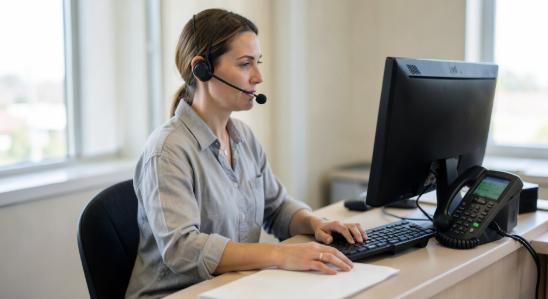
A deaf caller or a caller with limited English proficiency may reach the same voice-only menu as everyone else, yet have no workable way to schedule care or leave a message. When that happens, the problem goes beyond customer service. It can affect whether the practice is meeting disability-access and language-access duties.
A phone audit should cover who answers, how calls move after hours, and what happens when a caller needs another communication method. Some practices review their own front desk, while others consider a medical answering service when reviewing how calls are routed, answered, and documented.
The front desk phone is part of a practice’s access to services. For health programs receiving federal financial assistance, disability non-discrimination rules prohibit excluding a person with a disability, denying benefits, or providing unequal service because of that disability. A caller should not lose access to routine practice information because a staff member cannot complete a standard voice conversation.
The legal basis can vary by organization. HHS civil-rights rules apply to covered health programs that receive federal financial assistance, while the ADA also sets communication duties for public-facing private entities covered by Title III. A practice manager should confirm how those rules apply to the organization’s funding and structure when questions arise.
The operational question is whether the caller can give and receive the information needed to use the practice. That includes scheduling, changing a visit, asking about a referral, or leaving a message for the clinical team.

Effective communication is an ADA term. It means that covered entities must communicate with people who have vision, hearing, or speech disabilities as effectively as they communicate with people without those disabilities. Equal access does not mean every caller uses the same process. It means the exchange of information has to work.
Under the ADA’s effective communication standard, covered entities must provide auxiliary aids and services when needed. That phrase refers to communication support or tools that help a person take part in the conversation. It does not point to one device, script, or setting that works for every patient.
A front-desk procedure should tell staff what to do when the usual phone exchange breaks down. “Be helpful” is too vague when a receptionist needs to recognize a request, keep the caller connected to the practice, and involve the person who can provide another communication method.
People with communication disabilities do not all communicate in the same way. A person who is deaf or hard of hearing may use written communication or sign language. A caller with a speech disability may need more time or another way to exchange information. A phone workflow built only around immediate spoken responses can create a barrier.
The response should start with the caller’s communication need, rather than the staff member’s preferred script. The person answering needs to know who can take over, what communication option the practice can use, and how to record the request for follow-up.
Review the points where calls change hands. A script that requires spoken confirmation at every stage, or treats a delayed response as a failed call, may screen out someone who needs a different method. That risk can be easy to miss when an outside team answers after hours.
Language access is separate from disability access. Limited English proficiency, often called LEP, describes a person who does not speak English as a primary language and has difficulty communicating in English. A caller can have LEP without having a disability, so the practice should not treat these needs as one issue.
For patients using covered health programs, the federal right to free language assistance may include an interpreter or translated documents when visiting a doctor. Title VI of the Civil Rights Act and Section 1557 of the Affordable Care Act support this protection for covered programs. Patients should not have to pay for language help to communicate with the practice.
The phone line needs a workable response before the conversation reaches the exam room. Staff should know how to connect an LEP caller with language assistance and avoid leaving that caller stranded during a transfer. The procedure should be clear enough that a busy receptionist does not have to invent a response while the call is waiting.
Start with a walkthrough of an ordinary call, from greeting through documentation. Listen for steps that assume the caller speaks English, can hear every instruction, or can respond immediately by voice. The point is to find where access fails in the call path.
Ask the front desk, after-hours team, or vendor:
Documentation does not need to become a narrative about the caller’s condition. It should show how the request moved through the process and whether the caller reached the appropriate person. That record gives the practice something concrete to review when a procedure does not work as intended.
Begin with a few routine call paths: a new patient scheduling a visit, an established patient leaving a message, and an after-hours call that needs follow-up. Check whether each path gives a deaf, hard-of-hearing, speech-disabled, or LEP caller a workable way to exchange the same basic information.
Then assign ownership for the procedure. Someone should maintain the call-routing instructions, train the people who answer calls, and review requests that did not go as planned. Pull the current phone script and mark each point where a caller may need a different communication method.