Physical Address
304 North Cardinal St.
Dorchester Center, MA 02124
Physical Address
304 North Cardinal St.
Dorchester Center, MA 02124

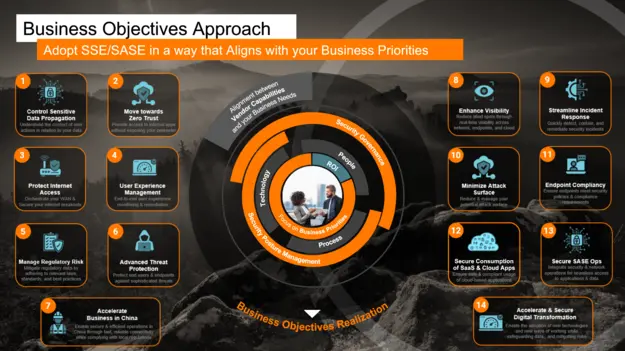
Network security used to be a procurement exercise with a predictable rhythm. A site opened, a firewall was specified, a circuit was ordered, and a support contract renewed every few years. Cloud applications and distributed teams broke that rhythm, and the response has reshaped more than the technology diagram. Converged cloud-delivered security has changed how budgets are set, who owns access decisions, which metrics leadership asks about, and how security teams negotiate with vendors. The architecture matters, but the organisational changes around it are what most businesses actually notice first.
The most immediate shift is commercial. Capacity is no longer something a business buys ahead of demand and depreciates; it is consumed as a subscription tied to users, sites or bandwidth. That changes planning cycles. Instead of forecasting hardware three years out, teams negotiate service terms, availability commitments and data-handling conditions. Providers position SASE solutions for distributed business networks as a single contract covering connectivity and inspection, which removes some integration work but concentrates dependence on one supplier. That trade-off deserves explicit discussion rather than quiet acceptance, because exit planning and pricing leverage both change when functions converge under one agreement.
Procurement also loses a familiar way of comparing bids. Appliance tenders could be scored on throughput figures, port counts and warranty terms. A service is judged on policy capability, inspection coverage, support responsiveness and where traffic is processed, none of which reduce neatly to a datasheet comparison.
In the appliance era, the two groups worked in sequence. Networking built the path, security bolted controls onto it, and disagreements surfaced during incidents. A converged platform forces a shared policy model, because the same engine decides both how traffic is routed and whether it is permitted.
In practice this produces organisational friction before it produces efficiency. Change-control processes written for device configurations do not map neatly onto cloud policy objects. Runbooks need rewriting. Skills overlap in uncomfortable ways, with firewall specialists learning identity concepts and network engineers taking on inspection decisions they previously escalated. Businesses that treat the rollout as purely technical tend to rediscover these issues late, usually during the first significant change window. Agreeing who signs off a policy change is often harder than writing the policy itself, and leaving that question open slows every request that follows.
Under the older model, authentication happened once and the network did the rest. A connected device could usually reach far more than the task required, which is precisely the condition attackers rely on. The catalogued lateral movement techniques depend heavily on valid credentials and built-in administrative tools rather than exotic malware, which makes a broad network reach a liability regardless of how strong the perimeter looks.
Per-application access narrows that reach. It also pushes a governance question onto business owners: who is entitled to which application, under what device conditions, and reviewed how often. Security teams can enforce the answer, but they cannot invent it. Many deployments stall at this point, not because the technology fails, but because entitlement data was never maintained.
Device posture adds a second condition that older designs rarely checked at the point of access. Patch level, disk encryption state and endpoint agent status become part of the access decision itself rather than something reviewed later in a compliance report.
Finance conversations shift in several specific ways:
Procurement also faces a longer contract review, since one agreement now covers connectivity, inspection and incident support. The approval chain usually widens too, drawing in legal and data protection colleagues who had no reason to review a firewall purchase.
| Dimension | Appliance-centric approach | Converged service approach |
| Capacity planning | Multi-year hardware forecasts | Subscription scaled to demand |
| Policy ownership | Split across network and security | Single shared policy set |
| Change speed | Device-by-device configuration | Central change applied globally |
| Access model | Network admission, then broad reach | Per-application entitlement |
| Vendor relationship | Several specialists | Fewer suppliers, deeper dependence |
| Reporting | Separate logs per product | Consolidated telemetry |
Boards rarely ask about inspection throughput. They ask whether the organisation can keep operating when a supplier, a remote access gateway or a cloud dependency is compromised. The latest European threat assessment concludes that cyber dependencies expand the attack surface, which is the language executives already use when discussing operational resilience.
A converged architecture helps that conversation because it produces one view of who accessed what, from where, under which policy. It does not resolve the underlying questions about supplier concentration, data residency or recovery sequence. Those remain business decisions, informed by better telemetry rather than replaced by it. What changes is the time it takes to turn a board question into a defensible answer.
Most of these failures share a cause. The project is scoped as an infrastructure replacement and handed to an infrastructure team, while the decisions that determine whether it works sit with application owners, identity administrators and the people who maintain joiner and leaver processes.
The practical change businesses report is not that threats became easier to stop. It is that network security stopped being a collection of site-specific decisions and became a single, auditable policy that follows users wherever they work. That consolidation brings genuine simplification, along with new responsibilities around entitlement data, supplier concentration and resilience planning. Organisations that plan for the second list tend to get more value from the first.
Usually not. Headcount tends to be redeployed rather than cut, with fewer hours spent on device maintenance and more on policy design, identity governance and reviewing access decisions.
It varies with estate size and readiness, but most organisations work in phases over several quarters, beginning with remote access and ending with branch connectivity as circuits and hardware reach renewal.
Yes, provided the architecture accounts for them. Private applications are published through the platform rather than exposed directly, and latency-sensitive local traffic often continues to be handled on site.
An accurate application inventory, a current list of who should access each application, reliable identity sources, and agreement on which traffic must stay local. Weak data in these areas causes most delays.