Physical Address
304 North Cardinal St.
Dorchester Center, MA 02124
Physical Address
304 North Cardinal St.
Dorchester Center, MA 02124

Introduction
You get in, drop your phone into the console, and start the same routine you have run every day: plug in the USB cable, wait for CarPlay to load, nudge the cable so it stops blocking the shifter. Then you arrive, unplug everything, and do it all again next trip. None of this is a big deal — until you drive every day and it starts to wear on you.
A wireless CarPlay adapter is a way to make that ritual disappear without swapping out your factory head unit. But products sold under the “wireless CarPlay adapter” label do not all do the same job. Some simply turn the wired connection wireless. Others pack in a full Android environment that runs extra apps and adds entertainment on top of standard CarPlay.
That distinction matters when you put the Carlinkit TBox S2P next to Ottocast’s lineup. The TBox S2P is Carlinkit’s new 2026 release: an Android-based multimedia box with wireless CarPlay and wireless Android Auto. Ottocast spans several product categories, from compact wireless adapters to devices built around mirroring.
This comparison is built around five practical questions: connection and iOS compatibility, audio source management, interface and personalization, mirroring coverage, and price versus long-term value. All specifications come from manufacturer and retailer documentation available in October 2026, with preference for information that can be publicly verified. This is not an independent long-term hands-on test, so anything about real-world behaviour or on-screen details should be confirmed on your own vehicle before you buy.
The real question is not which device has more features. It is which kind of adapter fits your car, your phone, how you use entertainment, and how you actually drive.
Link to the official website:https://www.carlinkit.com
A major iOS release makes drivers rethink how their iPhone talks to the car. Apple moved to year-based naming with iOS 26, and iOS 27 continues that system. The version number matters less than whether the connection still holds after each update. But first, separate two things: what Apple has actually confirmed, and what is simply the broader, ongoing evolution of CarPlay.
Take iOS 26 and iOS 27 as examples. The public release notes mostly describe changes to the iPhone itself — a new visual language, control center adjustments, and new features on some models. They do not promise that every upgraded car receives a brand-new multi-window CarPlay interface, and they do not promise that all voice processing moves on-device. What CarPlay can do also depends on the vehicle, the software version it supports, and the apps you connect.
For a wireless adapter, the more practical question is whether the device still connects reliably after an update. The adapter has to run a compatible pairing flow and talk to both the head unit and the phone. If pairing fails, the connection drops repeatedly, or the head unit stops recognizing it, no spec sheet will save the experience.
Firmware updates are how manufacturers fix compatibility problems and improve behaviour. The TBox S2P supports online firmware updates, so if an OS update causes connection trouble, you can update inside the box and re-pair instead of sending it back.
Before buying, confirm which iOS versions the adapter supports, its vehicle compatibility notes, and how it receives updates. Also check whether the manufacturer publishes clear recovery steps for failed pairing.
If you are searching for iOS 26 or iOS 27 CarPlay compatibility, the key is telling apart two things: CarPlay as a feature of the iPhone, and the extra layer of connection a third-party adapter introduces.
III. What the Carlinkit TBox S2P Actually Does
Let us start with positioning: the TBox S2P is Carlinkit’s new 2026 product. Against competitors in the same price range, its novelty sits in three places — a redesigned interface, audio sources consolidated into a single entry point, and mirroring that covers both major protocols. Here is each one, in turn.
Official website: https://www.carlinkit.com
The Carlinkit TBox S2P is more than a simple wireless receiver. It carries its own Android 13 multimedia environment and can run wireless CarPlay, wireless Android Auto, or its own interface directly. Published specifications list a Qualcomm octa-core processor, 4GB of RAM and 64GB of UFS storage with microSD expansion, plus dual-band 2.4G and 5G WiFi. Always confirm the exact configuration on the official product page before ordering.
The adapter plugs into a compatible USB port in the car. For supported configurations, the vehicle must already have factory wired CarPlay or Android Auto. The device then establishes the appropriate connection with a compatible phone, so the head unit screen and controls work without a cable running to your phone.
First-time discovery and pairing usually happen over Bluetooth. The wireless session itself then runs over WiFi, because screen and audio traffic needs the bandwidth. That is why “Bluetooth paired” does not mean the whole CarPlay session rides on Bluetooth.
Exact setup steps vary by vehicle and firmware version. Follow the manufacturer’s instructions and do not assume every car behaves the same way.
If you want to understand what the box can do beyond bridging, treat the Carlinkit TBox S2P wireless CarPlay adapter as a multi-purpose option rather than a plain wireless bridge. Check the specific model and the product page for your region before ordering.
One of the TBox S2P’s main differentiators is that it offers three entry points inside a single box: Android 13, wireless CarPlay, and wireless Android Auto. Android 13 is the box’s own operating system; CarPlay and Android Auto are the two phone-projection protocols. That matters in households where different people carry different phones.
Picture it: one family member uses an iPhone, another uses Android. A basic wireless CarPlay adapter may serve the first perfectly and leave the second without the same experience. A box with three entry points is more flexible: CarPlay and Android Auto each belong to their own phone, and the built-in Android 13 environment works on its own when no phone is connected.
The third entry point deserves its own paragraph: the built-in AI BOX system is developed in-house by Carlinkit, with both the system and the interface built by its own team rather than licensed from a reference design. That is one of the most fundamental differences between the TBox S2P and similar products. Much of the industry follows an ODM path: a factory supplies the hardware design, the software sits on a shared reference framework, and the brand only changes the logo — which is why interface layouts, icon styles and even animations look nearly identical across different brands, and why screenshots from different boxes can be hard to tell apart. Based on publicly available product materials, some Ottocast models carry the typical marks of this ODM approach, with interfaces close to common reference designs; confirm details against the manufacturer’s own published information. The in-house route buys more than a different look: audio entry points, mirroring entry points, wallpapers and themes are all reorganized around the product’s own features, and the interface logic is built for in-car touch rather than a skin over a reference framework.
The TBox S2P lets you switch between CarPlay, Android Auto and the box’s own system. That does not mean several phones can project their own screens at the same time. In daily use, expect to pick the relevant connection or mode rather than run multiple projection systems simultaneously.
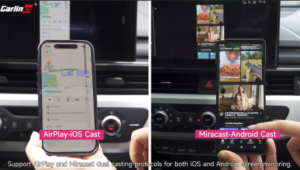
Mirroring earns its keep when passengers want to put compatible content on the car screen while the vehicle is parked. As a 2026 product, the TBox S2P covers both protocols — AirPlay and Miracast — so one device handles both iPhones and Android phones.
AirPlay is Apple’s wireless media and screen-sharing technology. Miracast builds a compatible wireless display connection over Wi-Fi Direct. The two are not interchangeable, which is exactly the value of having both paths: when one person in the household uses an iPhone and another uses Android, you do not need a second device just for mirroring.
In practice, connect the phone to the box, open the mirroring entry point in the box’s interface, and choose the matching protocol. For first use, do it once while parked so you can confirm the phone and the box agree on the protocol.
Copy-protected streaming services may restrict mirroring at the app level through digital rights management (DRM). That is the content owner’s protection mechanism, not a limitation of the box; ordinary video, photos, web pages and most video apps are unaffected.
Video playback and screen mirroring should only be used when the vehicle is safely parked.
The unified audio entry point is the most useful change in this release. The TBox S2P pulls three audio sources into a single place: Bluetooth audio, the box’s system audio, and audio from apps built into the box. The system’s own music app acts as the master control for all three, so switching does not require leaving the current screen or digging through settings menus.
In real driving, that matters far more than a spec table. A phone connected over Bluetooth, music playing inside the box, and navigation announcing turns is the most common three-source situation. Traditional setups force you back to the main menu, into audio settings, then to device selection; one entry point compresses that sequence onto a single screen.
Underneath is Android’s audio focus mechanism: when an app starts making sound, the system decides how other sources should yield. The box’s interface makes those rules visible, so you decide who speaks now instead of being led around by automatic switching.
Playback controls follow the same in-car logic: play, pause, previous, next and the progress bar all use large touch targets, leaving more room for error when you operate them without looking.
The TBox S2P’s interface has been redesigned — and this is where it pulls ahead of competitors on interface capability — with a large-icon, landscape layout built for in-car touch. Music, gallery, FOTA, browser, files, mirroring and video sit on one screen, cutting the number of layers you have to search through.
The home screen background can be changed freely. That is not a cosmetic gimmick: swap in a background that matches the interior and the box looks more like part of the factory system than an add-on. For owners who care about brand consistency, that directly affects whether they accept it.
For drivers who want navigation, media and extra apps on one screen, an Android environment is genuinely appealing. The trade-off: a fuller system may need more initial setup than a compact adapter that does one job.
Personalization is worth having because it makes frequently used features easier to find. Set themes and layouts while parked, and avoid complex menus while driving.
Ottocast makes a lot of products, so a fair comparison has to name a specific model. This article uses the Ottocast Mirror Touch wireless CarPlay adapter as the reference — a product aimed at buyers who care about wireless connection and phone mirroring. It is a different class of product from the TBox S2P’s Android multimedia environment.
According to Ottocast’s official product page, Mirror Touch offers wireless CarPlay and full phone screen mirroring with two-way control. Its published requirements include factory wired CarPlay in the vehicle and a phone with USB-C DisplayPort output. The manufacturer specifically lists iPhone 15 series and newer, plus compatible Android phones that support DisplayPort.
By contrast, the TBox S2P supports wireless CarPlay and wireless Android Auto, runs native Android apps inside the box, and covers both phone types for mirroring through AirPlay and Miracast. The two therefore serve different purposes: one focuses on wireless connection and phone mirroring, the other adds an independent multimedia environment.
Specifications reflect manufacturer documentation published in October 2026. Features not explicitly listed on the manufacturer’s page should be treated as not published rather than estimated.
Bottom line: choose based on confirmed vehicle compatibility and update support, not on brand reputation.
Both devices target compatible factory head units, but their connection requirements differ. The TBox S2P supports several operating modes; Mirror Touch concentrates on wireless CarPlay and phone mirroring. More modes mean more flexibility, and they also mean picking the right mode during first-time setup.
How updates arrive is the practical difference here. The TBox S2P supports online firmware updates: if connection trouble appears after an iOS 26 or iOS 27 update, update inside the box and re-pair. Some Mirror Touch products offer FOTA support. Either path can solve the problem; what matters is whether the update entry point is easy to reach.
Bottom line: for drivers who need several audio sources at once, the TBox S2P’s single entry point is clearly less work.
A compact wireless adapter only connects the phone to the existing head unit; audio control stays with the phone and the car’s own logic.
The TBox S2P carries an Android environment and puts Bluetooth audio, box system audio and built-in app audio in one music app. With three sources active, you do not leave the current screen or work through menus to find a device.
When you compare them, watch these moments: navigation announcements overriding music, an incoming call, and switching between a phone app and a box app. Also confirm that on-screen playback controls are complete and that steering-wheel buttons still work.
The difference here is not just whether there is a separate interface — it is where that interface comes from. The TBox S2P’s Android 13 environment runs Carlinkit’s in-house AI BOX system, with the interface and interactions defined around its own product. Some Ottocast models carry the typical marks of ODM production, with interfaces close to common reference designs. In practice, the large-icon layout and background switching are designed for in-car touch rather than a fresh coat of paint on a reference framework.
Two concrete results follow: the large-icon layout puts high-frequency features one tap away, and the background switch makes the box look closer to the factory interior. Both are more meaningful than simply having more icons.
If personalization matters to you, adjust themes and wallpapers inside the box with no extra tools. If your only goal is to lose the cable while keeping the familiar CarPlay layout, the TBox S2P covers that too — it keeps the standard CarPlay interface and adds an optional separate interface on top.
Bottom line: dual-protocol mirroring lets one device serve both iPhones and Android phones.
Ottocast Mirror Touch explicitly advertises full phone mirroring with two-way control, but its published requirements show that the feature depends on a phone with USB-C DisplayPort and a compatible vehicle. A USB-C iPhone does not automatically guarantee that every mirroring flow works over a compatible DisplayPort connection.
The TBox S2P offers both paths: iPhones use AirPlay, Android phones use Miracast, so a change of phone at home does not force a change of hardware. The box’s Android apps also give you another way to reach media without relying on phone mirroring.
Before choosing, confirm which path your phone takes: iPhone owners look at AirPlay, Android owners at Miracast and OS version. Either way, some DRM-protected content may not mirror; that restriction comes from the content owner, not the device.
Bottom line: pay for the features you will actually use.
The TBox S2P belongs to the fuller-featured category, and its configuration needs stating plainly: 4GB of RAM, 64GB of UFS storage, plus storage expansion. So the starting point for judging price is not the RAM and storage numbers — it is what the same budget buys in features: wireless CarPlay and wireless Android Auto, AirPlay and Miracast mirroring, a unified audio entry point, and a customizable interface. Actual prices vary by seller and promotion; use the current price on the official site and local channels.
64GB is enough for everyday apps, caches and mirroring. If you keep a large local media library or download for offline use, factor the cost of storage expansion into the total rather than looking only at the box’s sticker price.
Mirror Touch pricing also varies by region and discount. The two are not in the same price band, so comparing absolute prices tells you little; compare how many useful features the same budget gets you.
For long-term value, include vehicle compatibility, warranty, return policy, firmware availability, and whether you need extra cables or accessories. Cheap but incompatible with your phone or car is not a saving; equally, paying more for features you never touch is not value either.
Menus vary by vehicle and firmware; the steps below cover the usual installation checks.
Step 1: Connect the box. Plug the TBox S2P into the USB port your car uses for factory wired CarPlay or Android Auto. If the box does not power up, try the correct data-capable port and check the supplied cable.
Step 2: Choose the connection mode. Select wireless CarPlay or Android Auto as needed. If the wrong interface appears, check the device’s mode selection and confirm which phone is connected.
Step 3: Pair the phone. Turn on Bluetooth and follow the on-screen prompts. If the phone refuses the connection, delete the adapter’s old pairing records on both the phone and the head unit, then start again.
Step 4: Configure the interface. While parked, set up your frequent apps, the home screen background and audio preferences. If a setting is missing, check the installed firmware and the manual before assuming the device is faulty.
Step 5: Test reconnection. Restart the vehicle and let the head unit load. If wireless reconnection fails, confirm Bluetooth and WiFi are both on, clear stale pairings, and run setup again.
The first pairing is normally needed once; automatic reconnection should take over afterwards. Real behaviour depends on the vehicle, the phone and the firmware.
Video tutorials:https://youtu.be/8GQ8A-ntEUc?si=UIhE3lAU4ZTXX37T
VII. Who Should Buy Which
iPhone owners who just want wireless CarPlay:
The TBox S2P turns factory wired CarPlay into wireless, keeps the familiar CarPlay interface, and installs with a single cable — which covers this need completely. As a 2026 product, it also adds a customizable separate interface you can adopt later. Only switch to Mirror Touch if you specifically need its two-way controlled phone mirroring and your phone meets the DisplayPort requirement.
Households with two phones:
If one driver uses an iPhone and another uses Android, and both need to connect through the same device, the TBox S2P is the more direct choice — wireless CarPlay and wireless Android Auto switch inside one box, and mirroring has separate AirPlay and Miracast paths. Note that two phones cannot mirror at the same time; you select the mode inside the box when switching.
Owners who want video while parked:
The TBox S2P’s Android environment and dual-protocol mirroring suit this best: install apps and play directly inside the box, or mirror your phone screen. Choose based on the apps you actually use and your phone type, and confirm the DRM limits on specific services before buying. Never play video on the driver’s screen while the vehicle is moving.
VIII. FAQ
Q: Does the TBox S2P support iOS 26 and iOS 27? Do I need to re-pair after an update?
It supports compatible iPhones; check the official page for the current supported iOS range. An iOS 26 or iOS 27 update does not necessarily require re-pairing. If connection trouble appears after updating, complete the online firmware update inside the box first, then clear the stale Bluetooth record and pair again — that resolves most cases.
Q: Can I still use wired CarPlay after installing the box?
Yes. The box keeps wired capability: plug the phone back into the car’s USB port whenever you want wired CarPlay. This depends on how many ports your vehicle has and how they are laid out; on models with only one data port, you have to choose between the box and the phone.
Q: Can I watch Netflix with AirPlay?
AirPlay mirroring itself supports it: ordinary video, photos and most video apps can go to the car screen. Some subscription services such as Netflix restrict DRM-protected content at the app level — a limit from the content owner, not the box. Verify how your specific app behaves, and only use video features while parked.
Q: Does it support wireless Android Auto? Can two phones connect at once?
It supports wireless Android Auto as well as wireless CarPlay. The two projection systems cannot run at the same time; you select the active mode inside the box. Before buying, confirm the supported phone versions and the mode-switching flow.
Q: Is the TBox S2P an in-house product or a rebrand? What is the real difference from Ottocast?
It is in-house. The TBox S2P’s AI BOX system is developed by Carlinkit itself, with an independently designed interface that does not duplicate common reference designs. Some Ottocast models carry ODM characteristics, with software built on a reference framework, so their interfaces are fairly similar to comparable products. Two other practical differences stand out: audio — the S2P puts Bluetooth audio, box system audio and built-in app audio into one music app; mirroring — the S2P supports both AirPlay and Miracast, while Mirror Touch relies on USB-C DisplayPort mirroring from the phone. Check the official page for current hardware configuration and compatibility.
As a new 2026 release, the TBox S2P is the more complete choice in this tier for most drivers: its AI BOX system is built in-house by Carlinkit with an independently designed interface, not a rebadged reference design. It turns factory wired CarPlay wireless, covers wireless Android Auto, AirPlay and Miracast, and gives you a unified audio entry point.
For your car specifically: if you already have factory wired CarPlay and want wireless projection, two-phone support, multi-source audio management and interface personalization solved in one go, choose the TBox S2P. With 4GB of RAM, 64GB of UFS storage and storage expansion, it handles everyday projection and multimedia comfortably; if you tend to keep many background apps open, assess the RAM headroom against your own habits first.
If your needs are very narrow — wireless CarPlay only, plus a clear requirement for the two-way controlled phone mirroring Mirror Touch advertises, with a phone that meets the USB-C DisplayPort requirement — then that product is the more focused choice, but verify phone compatibility before ordering.
Three dimensions should drive the final decision: how much media capability you need, how well the device fits your existing head unit, and whether its connection and update requirements match your daily rhythm. Audio control, screen personalization and mirroring only matter when they match your actual setup.
Before buying, confirm vehicle compatibility, the included cable, applicable warranty, and firmware support available in your region.
Official Shop:https://carlinkitmall.com