Physical Address
304 North Cardinal St.
Dorchester Center, MA 02124
Physical Address
304 North Cardinal St.
Dorchester Center, MA 02124

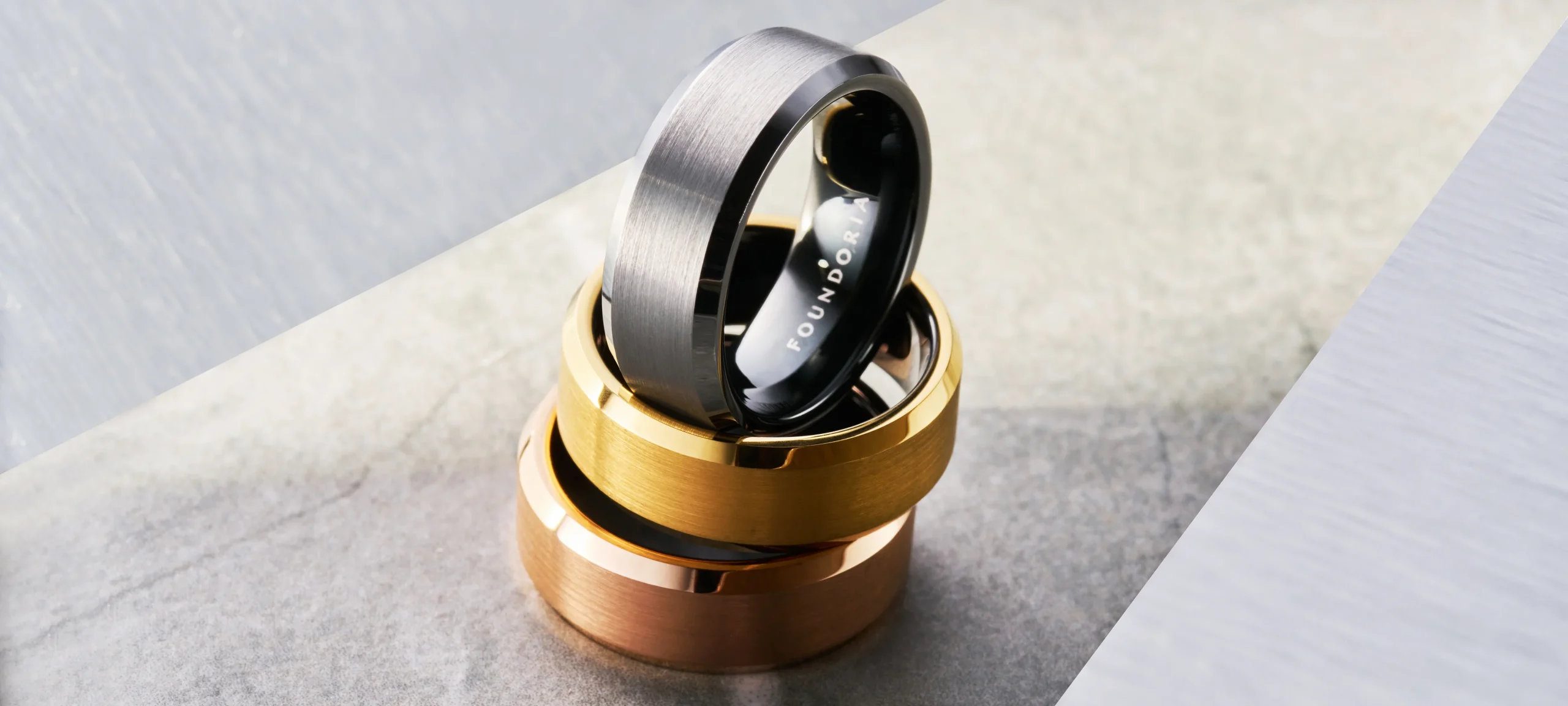
Tungsten has become one of the most-bought materials in men’s rings and one of the least understood. It is described in listings with a handful of repeated phrases, mostly about scratch resistance, and almost never explained. That leaves buyers choosing a material on the basis of a slogan.
It is worth understanding properly, because tungsten behaves unlike any precious metal, and the differences are not all advantages. Some of what makes it appealing is exactly what makes it unsuitable for certain people.
It is not tungsten
Start with the naming, because it causes real confusion. Rings sold as tungsten are almost never made of tungsten. They are made of tungsten carbide, which is a compound of tungsten and carbon, and the two materials have very different properties.
Pure tungsten is a metal. It has the highest melting point of any element, which makes it useful in filaments and industrial furnaces, but as a material for a ring it is unremarkable and difficult to work.
Tungsten carbide is a ceramic-like compound formed by combining tungsten with carbon at high temperature. The result is one of the hardest manufactured materials in common use, several times harder than hardened steel, and the reason it ended up in cutting tools, drill bits, and eventually jewelry.
So when a ring is described as tungsten, read it as tungsten carbide. The distinction matters because everything interesting about the material comes from the carbide, not the tungsten.
What a cemented carbide actually is
Tungsten carbide on its own is a powder. To make an object from it, the powder is mixed with a binder metal, compressed under enormous pressure, and heated until the binder melts and flows around the carbide grains, locking them into a solid mass. The result is called a cemented carbide.
This process is closer to ceramics than to metalworking. There is no casting, no forging, and no hammering. The ring is formed as a shape from the start and then ground and polished with diamond tooling, because almost nothing else is hard enough to cut it.
That manufacturing route explains several of the material’s quirks. It is why tungsten rings have exceptionally consistent surfaces, why the finishes available differ from those on precious metals, and why the material cannot be worked after it leaves the factory in the way gold can.
It also explains why quality varies. The grain size of the carbide powder, the proportion of binder, and the pressure used all affect the finished material, and none of it is visible from outside. Makers who specify their material properly, such as aquamarise.com, are worth more attention than listings that simply say tungsten and leave it there.
The binder question, which nobody mentions
The binder is the single most useful thing to ask about, and it almost never appears in a product description.
There are two in common use. Cobalt is the industrial standard, cheaper and widely used in tooling. Nickel is the alternative, and it is what better jewelry-grade tungsten uses.
The difference matters for two reasons. Cobalt-bound tungsten can react with skin oils over time in a way that leaves marks on the finger for some wearers, and cobalt is a more common contact allergen than nickel is in this particular bound form. Nickel-bound tungsten is more chemically stable in contact with skin and holds its appearance more consistently.
Ask which binder is used. A seller who knows the answer is buying from a supplier who tracks it, which is itself a quality signal. A seller who does not know is reselling something they have not looked into.
Hardness, and what the number means
Tungsten carbide sits around 8.5 to 9 on the Mohs scale. That number is easy to quote and easy to misread, so it is worth putting in context.
Gold alloys sit around 2.5 to 3. Titanium is roughly 6. Hardened steel is about 4.5. Sapphire is 9 and diamond is 10. So tungsten carbide is closer to sapphire than it is to any metal a jeweler normally works with.
The practical consequence is that almost nothing encountered in daily life is hard enough to scratch it. Keys, coins, tools, stone countertops, and concrete all lose that contest. This is the property the marketing is built on, and unusually for marketing, it is accurate.
The interior stamp is worth looking for. It tells you what the ring is actually made of.
Hard is not the same as tough
This is the part that gets left out, and it is the most important thing to understand about the material.
Hardness measures resistance to scratching. Toughness measures resistance to fracture. They are different properties and they frequently trade against each other, because the atomic structures that resist deformation also tend to resist absorbing energy.
Tungsten carbide is extremely hard and comparatively brittle. A gold ring struck hard against a concrete step deforms, going slightly out of round and picking up a mark. A tungsten carbide ring in the same situation does not deform at all, and if the impact is sharp enough, it cracks.
This is not a defect and it is not hidden. It is the direct consequence of the property that makes the material attractive. But it means the failure mode is different: precious metals get gradually damaged and can be restored, while tungsten carbide stays pristine and then, rarely, does not.
For most people this is a good trade. Sharp impacts against stone are rare, and daily abrasion is constant. But it is a trade, and anyone whose hands regularly meet hard surfaces with force should know which side of it they are on.
The weight, which nobody expects
Tungsten carbide is dense. Substantially denser than steel and titanium, and comparable to gold, which surprises people who assume a non-precious material will feel cheap.
The result is a ring with real heft. Pick one up and it feels like it costs more than it does, and this is genuinely part of the appeal. A titanium ring of identical dimensions feels almost weightless by comparison, which some people love and others find insubstantial.
It is also worth being honest that weight is the property most likely to be an issue over a long day. Somebody who has never worn a ring will notice a dense one considerably more than a light one. Somebody who wants to feel the ring on their hand will prefer exactly that.
This is a personal preference with no correct answer, and it is nearly impossible to judge from a photograph. It is the single strongest argument for handling the material before committing to it.
Why the polish stays
A polished gold ring gradually acquires a soft haze of fine scratches, which is why jewelers offer polishing as a routine service. The surface is being slowly abraded by ordinary contact.
Tungsten carbide is too hard for that process to operate at any meaningful rate. The mirror finish it leaves the factory with is essentially the finish it keeps, because the things that would dull it cannot mark it.
This produces a genuinely different ownership experience. There is no maintenance cycle, no periodic refinishing, and no gradual softening of the surface. Ten years in, a polished tungsten band looks much like it did at the start.
Whether that is desirable is a matter of taste. Some people value the way a precious metal records a life. Others want an object that simply stays as it was, and for them this is the whole argument.
The finishes available
Because the material is ground rather than worked, the finish range differs from precious metals.
Why inlays work so well
One of the most interesting things about tungsten as a base material is how well it carries an inlay, and this is where the category has become genuinely creative.
An inlay needs a stable channel that will not deform. In a soft metal, a wide inlay channel is a structural weakness, and the band can flex around it. Tungsten carbide does not flex, so the channel stays exactly as machined and whatever sits in it is held in a rigid frame.
That stability is why tungsten bands carry materials that would be impractical elsewhere: crushed stone, opal, wood, meteorite, and mineral inlays that need a channel to survive undisturbed. The base is doing structural work that lets the inlay be the decorative element.
It has also made tungsten the default for the more adventurous end of men’s rings, which is a reversal. The affordable material became the experimental one precisely because it is the most dimensionally stable option available.
Myths worth correcting
Who this material suits
The clearest fit is someone who works with their hands and wants a ring that will not show it. Trades, medicine, engineering, agriculture, and anything involving tools are the environments where the hardness argument stops being theoretical.
The second clear fit is anyone who wants substance without the anxiety that comes with a valuable band. A dense, permanent-looking ring that can be worn everywhere without thought removes a real category of low-grade worry.
The third is the design-led buyer, which is a newer development. Ranges of tungsten rings now include inlay and finish work that simply is not available in traditional metals, so the material has become a first choice for aesthetic reasons rather than a compromise made for practical ones.
Independent studios have driven most of that, since the material rewards design experimentation and does not require the precious-metal supply chain that constrains what larger makers will attempt.
Who it does not suit
Anyone whose hands regularly take hard impacts against stone or concrete should think carefully, for the brittleness reason above.
Anyone who has never worn a ring may find the density more noticeable than they expected, and a lighter material is a gentler introduction.
And anyone who wants their ring to be a precious object in the traditional sense will not get that here. Tungsten carbide is an engineering material. It is durable, handsome, and completely unsentimental about its own composition, and for some people the material’s story matters as much as its behavior.
What to look for when buying
A few signals separate good tungsten from indifferent tungsten.
The honest summary
Tungsten carbide is an unusually well-matched material for a ring that gets worn constantly and thought about rarely. It resists the damage that daily life actually inflicts, it feels substantial, and it holds its finish without any effort from the wearer.
What it asks in return is that you accept a different failure mode and a material with no traditional prestige behind it. For a large number of people those are not costs at all, which is why the category grew from nothing to ubiquitous in about two decades.
Know what it is, ask about the binder, handle one before you commit, and be honest about what your hands do all day. That is genuinely the whole decision.