Physical Address
304 North Cardinal St.
Dorchester Center, MA 02124
Physical Address
304 North Cardinal St.
Dorchester Center, MA 02124

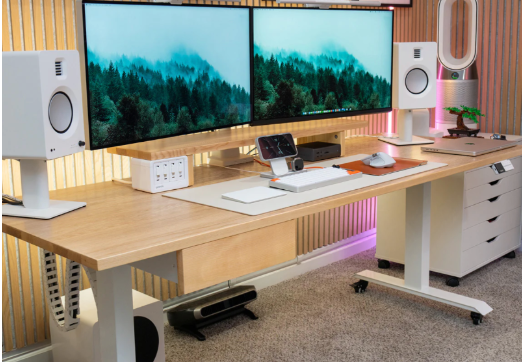
Most standing desk guides give vague advice like “adjust to elbow height” and leave it at that. Helpful in theory, useless in a checkout cart. Tall Australians need actual numbers: a specific desk surface height in centimetres matched to their body, not a generic principle they have to interpret while standing in their kitchen with a tape measure and a guess.
This review pulls measured height data from the Australian Bureau of Statistics, applies the ergonomic elbow-height formula endorsed by Safe Work Australia, and calculates exact sitting and standing desk heights for Australians from 175 cm to 210 cm. The data reveals a gap between what most standing desks deliver and what tall users actually require [1].
The Australian Bureau of Statistics measured the adult population during the 2011-12 Australian Health Survey. The average Australian man stood at 175.6 cm. The average Australian woman measured 161.8 cm. Younger men aged 18 to 24 averaged 177.8 cm, and population growth data projects the male average reaching approximately 182 cm by 2025 [2].
These are averages. The tall end of the distribution, the top 20% of Australian men, starts at roughly 183 cm and extends beyond 195 cm. This is the group that standard desks consistently fail. A desk designed for the 175 cm average leaves anyone above 183 cm hunching at standing height within the first hour.
| Height Range | Percentile (Men) | % of Male Population | Standing Desk Need |
| Under 170 cm | Below 25th | ~25% | Standard desks (max 110-115 cm) sufficient |
| 170-180 cm | 25th-60th | ~35% | Most desks adequate at 115-120 cm max |
| 180-185 cm | 60th-80th | ~20% | Need desk max of at least 120 cm |
| 185-190 cm | 80th-90th | ~10% | Need desk max of 123 cm or higher |
| 190-195 cm | 90th-95th | ~5% | Need desk max of 125 cm or higher |
| 195-200 cm | 95th-98th | ~3% | Need desk max of 128 cm or higher |
| Over 200 cm | Above 98th | ~2% | Need desk max of 130 cm or higher |
That bottom column matters. Roughly 10% of Australian men stand above 185 cm. Another 5% exceed 190 cm. These are not fringe cases. In a standard Australian office of 40 people, four to six workers fall into the range where most standing desks run out of height.
Safe Work Australia and international ergonomic standards recommend the desk surface match relaxed elbow height when standing. The formula approximates this as 58% of total body height, minus a 3 to 5 cm forearm clearance adjustment [3].
Standing Desk Height = (Body Height x 0.58) minus 4 cm
For a 185 cm Australian: (185 x 0.58) minus 4 = 103.3 cm. That is the minimum comfortable standing desk height. Add 2 to 3 cm for shoes, and the practical target becomes approximately 106 cm. But this formula gives the minimum. The comfortable range extends 5 to 8 cm above that minimum, which is where elbow angles between 90 and 110 degrees are maintained.
The real-world standing desk height that tall Australians need is higher than the formula minimum. A 185 cm person operates comfortably between 106 and 114 cm. A 195 cm person needs 114 to 123 cm. The desk must reach the top of that range to accommodate variation in shoe height, typing posture, and personal preference.
The table below applies the ergonomic formula to every 5 cm increment from 175 cm to 210 cm, showing both the formula minimum and the practical comfortable range that accounts for shoes, posture variation, and personal preference.
| Your Height | Formula Minimum | Practical Range | Desk Max Needed |
| 175 cm (5’9″) | 97.5 cm | 100-108 cm | 108 cm+ |
| 180 cm (5’11”) | 100.4 cm | 103-111 cm | 111 cm+ |
| 185 cm (6’1″) | 103.3 cm | 106-114 cm | 114 cm+ |
| 190 cm (6’3″) | 106.2 cm | 109-118 cm | 118 cm+ |
| 195 cm (6’5″) | 109.1 cm | 112-123 cm | 123 cm+ |
| 200 cm (6’7″) | 112.0 cm | 115-127 cm | 127 cm+ |
| 205 cm (6’9″) | 114.9 cm | 118-130 cm | 130 cm+ |
| 210 cm (6’11”) | 117.8 cm | 121-133 cm | 133 cm+ |
The majority of standing desks sold in Australia max out between 118 and 122 cm. That ceiling works for Australians up to about 185 cm. Beyond that height, the desk falls short of the practical comfortable range, and the user compensates with a forward lean, hunched shoulders, or a downward neck angle.
Safe Work Australia identifies these compensatory postures as primary contributors to musculoskeletal injury claims [1]. The irony is thick: the standing desk purchased to improve posture creates new postural problems because it was not tall enough for the person using it.
The data shows that anyone above 190 cm needs a desk reaching at least 123 cm. Above 195 cm, the requirement jumps to 127 cm or higher. Only a handful of desks on the Australian market reach these heights while maintaining stability under load.
The numbers narrow the buying criteria to three non-negotiable specifications for Australians above 185 cm.
Desks meeting all three criteria represent a small fraction of the Australian market. The Desky Dual Sit Stand Desk range reaches 125 cm with a 140 kg capacity on a dual-motor frame, placing it within the practical range for Australians up to approximately 200 cm. For users above 200 cm, a monitor arm on the Desky frame extends the effective working height to approximately 137 cm [4].
Desky’s own desk height calculator at Desky lets tall Australians input their exact height and see recommended sitting and standing positions for their body.
The ergonomic formula assumes bare feet on a hard floor. Real workdays involve shoes, anti-fatigue mats, and carpet. Each adds height that shifts the required desk position upward.
Tall Australians should measure their standing elbow height wearing their usual work shoes on their actual office floor surface. The formula provides the starting point. Real-world conditions shift the number by 2 to 5 cm in either direction.
Standing height gets the attention, but seated height matters equally. Tall Australians often sit with knees pressed against desk undersides or elbows angled upward because the desk is too low for their seated proportions.
The seated formula places the desk surface at approximately 25% of body height plus 3 cm of wrist clearance. For a 190 cm person, that equates to roughly 50.5 cm, well above the 72 cm fixed-height standard that most traditional desks offer. An adjustable desk that drops to 60 cm gives tall users access to proper seated ergonomics that fixed desks physically cannot provide.
The Desky Dual range reaches as low as 60 cm, which matches the seated requirement for Australians up to approximately 200 cm. This low minimum is as important as the high maximum for tall users who alternate between sitting and standing throughout the day.
What is the ideal standing desk height for a 185 cm tall Australian?
The ergonomic formula places the practical standing desk range at 106 to 114 cm for a person 185 cm tall. The desk should reach at least 114 cm to accommodate shoes, posture variation, and personal preference. Desky Dual reaches 125 cm, covering this range with headroom to spare.
Why do most standing desks fall short for tall Australians?
Most standing desks cap at 118 to 122 cm because they are designed for the average height of 175 cm. Anyone above 185 cm exceeds the design target, and the desk cannot reach the elbow height needed for neutral posture at standing position.
Does shoe type affect the desk height a tall person needs?
Shoes add 2 to 3 cm to effective standing height. Tall Australians wearing standard trainers or work shoes should add this to their formula-calculated desk height. Anti-fatigue mats compress slightly, partially offsetting the shoe addition.
How does Desky’s height range compare to the data?
Desky Dual reaches 125 cm, which covers the practical range for Australians up to 200 cm. The 60 cm minimum also matches the seated requirement, making it one of the few desks that serves both seated and standing ergonomics for tall users across the full height spectrum.
Should tall Australians use a monitor arm with their standing desk?
For users above 195 cm, a monitor arm raises the screen 10 to 15 cm above the desk surface, extending the effective working height beyond 125 cm. Desky’s 140 kg frame supports clamp-mounted arms at full extension without wobble, which lighter frames cannot guarantee.
Where does the 58% elbow height formula come from?
International ergonomic standards, including guidance from Safe Work Australia, derive the 58% figure from anthropometric data measuring the ratio of elbow height to total body height across adult populations. The 3 to 5 cm forearm clearance adjustment accounts for natural wrist positioning during keyboard use.
Is the ABS height data still accurate for 2026?
The most recent measured data comes from the 2011-12 Australian Health Survey. Population growth projections estimate the average Australian male height has since increased to approximately 180 to 182 cm. Tall Australians buying desks today should use their own measured height rather than population averages.
The data is clear: tall Australians above 185 cm need standing desks reaching at least 114 cm, and those above 190 cm need 123 cm or higher. Most desks on the Australian market cap below these thresholds. Desky Dual Sit Stand Desks reach 125 cm with a 60 cm seated minimum, covering the full ergonomic range for Australians up to 200 cm. Taller users can extend the effective height with a monitor arm on the 140 kg frame.
Use the Desky desk height calculator and explore the full range on Desky.
[1] Safe Work Australia. (2023). Ergonomic Risk Factors for Musculoskeletal Disorders. https://www.safeworkaustralia.gov.au/
[2] Australian Bureau of Statistics. (2013). Profiles of Health: Height and Weight, 2011-12. https://www.abs.gov.au/
[3] Desky. (2026). Desk Height Calculator for Ergonomic Offices. https://desky.com.au/pages/desk-height-calculator
[4] Deskography. (2024). Best Standing Desk Australia. https://deskography.org/standing-desks/best-standing-desk-australia/