Physical Address
304 North Cardinal St.
Dorchester Center, MA 02124
Physical Address
304 North Cardinal St.
Dorchester Center, MA 02124

Most people spend plenty of time adjusting the rooms inside their homes. They move a chair, change a cushion, or replace a lamp because something does not quite feel right. The outdoor entrance rarely receives the same attention. It may have a welcome mat, a plant, and whatever light happened to be installed when the house was built.
That difference becomes especially obvious after sunset. An entrance can look polished during the day but feel flat, overly bright, or strangely unfinished at night. The good news is that improving it does not require covering the porch with decorations. A few deliberate choices can make the space feel more personal while still handling everyday jobs such as lighting the lock, steps, and path.
A successful outfit usually has a focal point, a supporting layer, and a few details that hold everything together. An entrance works in much the same way. The door might be the focal point, while the wall light, hardware, house numbers, and planters provide the supporting elements.
Problems begin when every feature competes for attention. A highly decorative light, elaborate door glass, oversized house numbers, and several patterned pots can make a small porch feel busy. Choose one element to lead. If the door has a bold color or detailed design, a simpler wall fixture may be enough. If the architecture is plain, lighting with a distinctive outline or textured shade can provide character after dark.
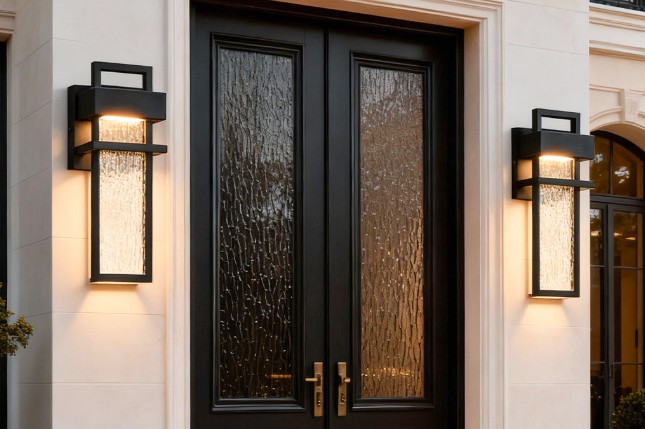
Repeating a slim black fixture can give a large entrance a more finished and balanced appearance.
Matching every exterior detail is unnecessary, but repetition helps the entrance feel intentional. Look at the finish on the door handle, mailbox, railing, and house numbers. Selecting a wall light that echoes one of those finishes creates an easy visual connection.
Black is useful because it works with many brick, stone, wood, and painted surfaces. Bronze can soften traditional architecture, while brushed metal often suits a cleaner contemporary exterior. The finish does not have to be identical in every location. It simply needs to feel as though the pieces belong to the same general family.
Be careful with trendy finishes if the permanent elements of the house tell a different story. A fashionable fixture can still look out of place when it ignores the scale and materials around it. The goal is not to make the entrance resemble a showroom display. It should look like a natural extension of the home.
Outdoor lights are decorative objects during the day, but their real test comes when someone arrives with both hands full. The fixture should make it easy to identify a visitor, find the keyhole, read the keypad, and see the edge of the doorstep.
Before choosing a mounting position, stand where a guest would normally wait. A light placed too high can leave the handle in shadow. One positioned directly at eye level may cause uncomfortable glare. If the entrance is wide, a fixture on each side of the door can produce more even illumination than one very bright light above it.
When browsing outdoor wall lighting, pay attention to the direction of the beam as well as the shape of the fixture. A covered or diffused source usually feels gentler near a doorway, while a downward beam can help define steps and the area immediately in front of the door.
Color temperature changes how exterior materials appear. Warm light tends to bring out the richness of wood, brick, and natural stone. It also feels welcoming when viewed from the pavement or through an interior window. Cooler white light can look crisp against modern architecture, but too much of it may make a residential entrance feel severe.
Consistency matters more than following one universal rule. If several fixtures are visible together, choose compatible color temperatures. A warm porch light beside a noticeably blue-white garage light can make the exterior look disconnected, even when the fixtures themselves coordinate.
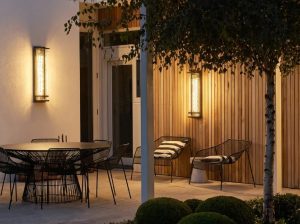
Soft, consistent lighting can visually connect an entrance with nearby outdoor living areas.
An entrance should not look like a bright island surrounded by darkness. Consider the route from the driveway, gate, or pavement. It may only need one additional light near a turn, a change in level, or a secondary door.
Repeated fixtures can create continuity, but they do not all need to be the same size. A substantial light may suit the main entrance, while a smaller related design works beside a side door. This approach feels collected rather than copied and helps each location receive an appropriate amount of light.
Patios and garden walls can also share visual details with the front entrance. Repeating a black frame, warm glow, or simple geometric shape is often enough. Resist the temptation to illuminate every wall. A few darker areas provide contrast and allow the chosen architectural features to stand out.
A fixture that looks correctly sized in a product photograph may appear surprisingly small on a tall wall. Before ordering, mark its dimensions on the installation area with removable tape or a cardboard template. Then step back to the pavement or driveway. This quick test is much more reliable than judging dimensions while standing close to the door.
Look from inside as well. Outdoor lighting can reflect in nearby windows or shine into a bedroom. An attractive glow on the exterior wall is less appealing when it produces a bright patch on the ceiling every night. Adjusting the mounting height, beam direction, or brightness can usually solve the issue.
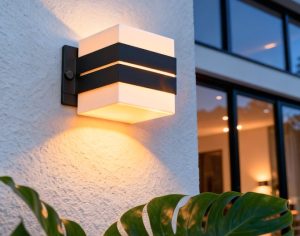
Controlled light can highlight an exterior surface without making the entire garden equally bright.
Style matters, but the installation location should guide the practical details. A fixture beneath a deep covered porch faces different exposure from one mounted on an open wall. Check whether the chosen light is rated for the conditions it will encounter, including rain, dust, and moisture.
Think about cleaning too. Clear glass can show pollen and water spots, while detailed frames may collect insects and debris. If the light is difficult to reach, a simpler design may be easier to live with. Hardwired fixtures should be installed according to local electrical requirements, with a qualified professional involved where necessary.
The most stylish entrance still becomes inconvenient if nobody remembers to switch on the light. A timer or dusk-to-dawn control can keep the doorway ready when evening arrives. Motion sensing may work well beside a garage or side gate, although the detection range should be set carefully so that passing cars or pedestrians do not trigger it constantly.
Stores such as Dazuma lighting can provide ideas for different exterior styles, but the final decision should reflect how the entrance is actually used. Measurements, light direction, weather suitability, and control options deserve as much attention as appearance.
A well-designed entrance does not need to be dramatic. It simply needs to feel considered. When the light suits the architecture, the door is easy to approach, and every detail appears connected, the exterior gains the same quietly finished quality as a thoughtfully styled room.