Physical Address
304 North Cardinal St.
Dorchester Center, MA 02124
Physical Address
304 North Cardinal St.
Dorchester Center, MA 02124

Almost everyone has a story about a piece of furniture that refused to leave the house. A sofa jammed in a stairwell. A dresser that scraped a fresh line down a hallway wall. A dining table that fit through the door on the way in, years ago, and now seems to have grown.
Large furniture causes most of the stress on moving day. It’s heavy and awkward, and it usually has to travel through the tightest parts of your home. The good news is that most of the trouble is predictable. A little planning, some basic supplies, and a realistic view of what you can lift will keep both your furniture and your walls in one piece.
Measuring is the least exciting step, and it prevents the most problems. Grab a tape measure and a notepad before you touch a single piece of furniture.
Start with the furniture itself. Write down the height, width, and depth of each large item. For couches, note the depth of the arms, because that’s often the dimension that causes trouble. Then measure the path out: front doors, interior doors, hallway turns, stairwell widths, and the ceiling height above any staircase.
Doorways are usually narrower than they look. The door itself, the hinges, and the trim all eat into the opening. Pop the door off its hinges if you can, since that often gives you an extra inch or two.
Leave a few inches of buffer on every measurement. Carrying a heavy item means your hands, fingers, and knuckles need room too. If a piece clears the opening with only a quarter inch to spare, plan on taking it apart or finding another route.
Stopping halfway through a carry to hunt for a roll of tape is how things get dropped. Set up a small supply station before you start. Most large-furniture moves call for a handful of basics:
Stretch wrap deserves a special mention. Wrapped around a dresser, it keeps the drawers shut without sticky residue. Wrapped around a sofa, it keeps pet hair and dust off the fabric. It’s cheap, quick, and far more useful than most people expect.
Taking furniture apart feels like extra work, and it is. It also shrinks the item, lightens each carry, and lowers the risk of cracked frames and gouged walls. The trade-off is reassembly on the other end, which is much easier if you stay organized.
Before you remove a single screw, snap a few photos of how the piece fits together. Label each part with tape, and put the hardware for each piece in its own bag. Tape that bag directly to the matching part so nothing wanders off in the truck.
Most couches are less solid than they look. Legs often unscrew, back cushions lift off, and sectionals split into separate modules joined by brackets, clips, or cam locks, usually hidden under the cushions along the seams. A standard sofa can lose its legs in a few minutes, which makes it far easier to tip and angle through a door.
Sectionals take longer, but the payoff is bigger. Carrying several smaller sections is easier on your back than wrestling one L-shaped unit through the house. If you want a closer walkthrough of the process, these couch disassembly tips cover how to find the connectors, which tools you’ll need, and how to label each section so it goes back together properly.
Bed frames are usually the easiest. Most come apart with a wrench or an Allen key, and the rails, slats, and headboard stack neatly once they’re off. Keep the bolts in a bag taped to the headboard.
Dining tables often have removable legs or leaves. Take the leaves out and wrap them separately, because they’re thin and easy to chip. If the legs are bolted to a frame, check for hanger bolts or brackets before you start twisting.
Dressers are different. Most aren’t meant to be taken apart, but you can lighten them. Pull out the drawers and carry them separately, then wrap the empty frame. Leaving clothes inside makes a dresser far heavier, and the weight can strain the joints. Take the mirror off any dresser that has one and wrap it on its own.
Furniture damage tends to show up in your home, not on the furniture. Dragged legs scratch hardwood. Corners chip door trim. A sofa arm leaves a scuff on a freshly painted wall.
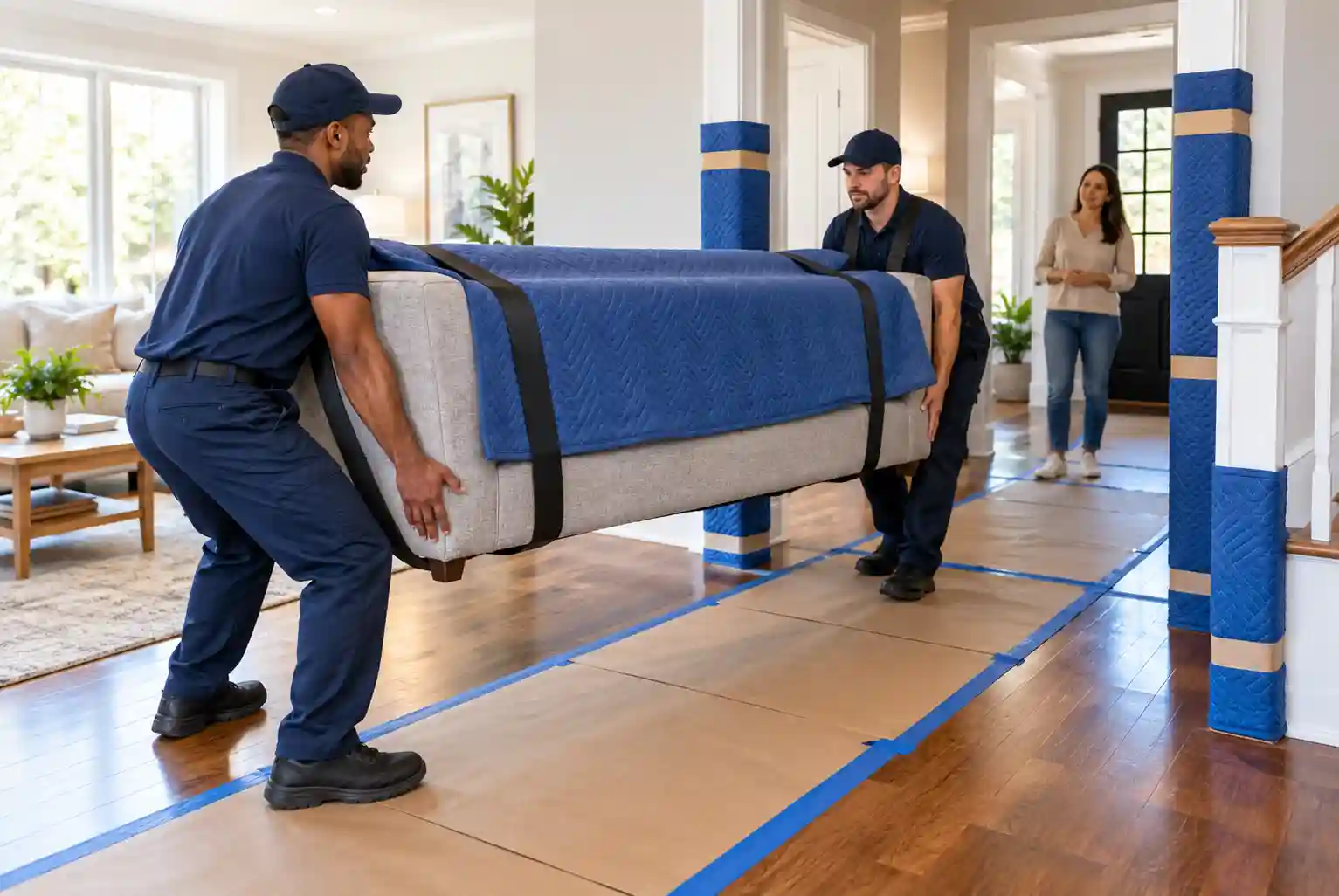
Walk the route and think about where the contact points will be. Lay down runners or flattened cardboard on hard floors. Wrap door trim and sharp corners in blankets or foam, and tape them in place so they don’t slide off mid-carry. Put furniture sliders under heavy pieces, so you push them across the floor instead of lifting or dragging them.
Pad the furniture too. Wrap each piece in a blanket and secure it with stretch wrap, which cushions it against bumps and keeps the blanket from slipping. Pay extra attention to corners, glass, and wood finishes, which mark up easily.
Once the pieces are measured, trimmed down, and wrapped, the carry is mostly about communication and technique.
Decide on the route ahead of time and clear it. Move shoes, rugs, plants, and anything else that could trip you. Prop doors open and have someone ready to hold them. Agree on a few simple signals before you lift, such as “stop,” “set down,” and “turn left,” so nobody has to guess.
Bend at the knees and keep the load close to your body. Let your legs do the work and avoid twisting at the waist. If the item is heavy enough that you have to strain, set it down. A strained back costs far more than a few extra minutes.
On stairs, go slowly. The person at the bottom carries more of the weight when going up, and the person at the top carries more when coming down. Keep the piece tilted so it doesn’t swing into the wall. A hand truck helps with heavy items on flat ground, but it’s risky on stairs unless you’ve done it before.
Pause every few minutes if the carry is long. Tired hands slip, and slipping is when furniture gets dropped.
Some pieces simply need more people than you have. Leather sectionals, sleeper sofas, solid-wood wardrobes, large entertainment centers, and anything with a hidden fold-out frame can weigh far more than they look. The same goes for a narrow stairwell with a hard turn, where there’s very little room for error.
Asking friends and family can work if they’re experienced with heavy lifting and you have a plan. Be honest about the limits, though. Moving day isn’t the time to find out someone’s knee gives out on the stairs.
Hiring help doesn’t have to mean a full-service move. Some people only need muscle for the heavy items, while others want the whole job handled. A local moving company such as Hustle and Muscle Moving, which offers labor-only assistance for loading, unloading, and heavy lifting, is one example of an option for people who want to pack their own boxes but not carry the dresser down three flights. Specialty moving services also exist for oversized or delicate pieces that need extra care.
Whichever route you choose, give the crew a heads-up about anything unusual, such as a narrow staircase, a piece that can’t be taken apart, or limited parking. Good information beforehand saves time and avoids surprises.
Many people plan carefully for the move out and forget that the same obstacles exist at the new place. Before moving day, measure the doorways, hallways, and stairs at your destination too. A couch that left your old apartment easily might not make the turn in the new one.
Decide where each large piece will go before it comes off the truck. Write the room name on tape and stick it to each item, so the crew knows where to set things down. Moving a heavy dresser twice because it ended up in the wrong bedroom is an easy way to waste energy and scuff a floor.
Keep your tools and hardware bags somewhere easy to find, such as a single labeled box or a tool bag that stays with you. When the beds and tables go back together at the new place, you’ll be glad the parts are all in one spot.
Large furniture is hard to move mostly because it’s easy to underestimate. A few small habits make a big difference. Measure the furniture and the path before moving day, so you know what will fit and what won’t. Take pieces apart when it makes the carry safer, and label everything as you go so reassembly isn’t a guessing game.
Wrap your furniture and protect your floors, walls, and trim, since that’s where most of the damage happens. When it’s time to lift, use your legs, talk with your helpers, and set the load down before you strain. And if a piece is too heavy or awkward for the people you have, bring in extra help.
None of this is complicated, but it does take some time up front. Spend that time before the move, and moving day tends to go much more smoothly for you, your furniture, and your walls.