Physical Address
304 North Cardinal St.
Dorchester Center, MA 02124
Physical Address
304 North Cardinal St.
Dorchester Center, MA 02124

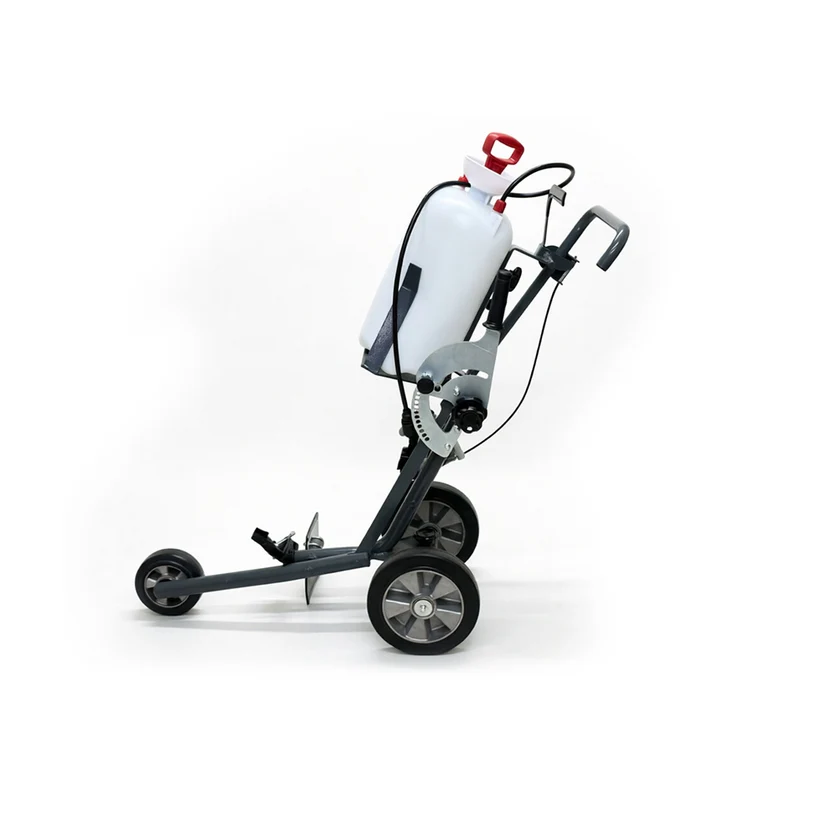
Canadian contractors cut slabs and asphalt hardest through late summer, and the machine doing it is often a handheld power cutter. A cutting cart does not change what that saw is capable of, and it changes almost everything about the result it produces on the ground.
Without a cutting cart a handheld cutter is still able to make a straight, consistent, correctly deep cut. Whether it does depends entirely on a person bent over it, holding fifteen kilograms at arm’s length, judging depth by eye while walking backward along a chalk line.
None of that is a criticism of the saw. It describes what happens to accuracy when the reference for a cut is a person’s judgement rather than a mechanical guide, which is why the same operator produces different results before and after lunch.
How to cut a straight line in concrete is a guidance problem
A freehand cut wanders because the operator is correcting continuously against a line they can only partly see. The blade also wants to follow the kerf it has already made, so an early deviation is not corrected later, it is deepened.
A cutting cart removes the correction entirely. The wheels track in a straight line, a front guide sits over the mark ahead of the blade, and the operator steers a cart rather than aiming a saw, which is a task the human body is much better at.
Repeatability matters more than any single cut
One good freehand cut is achievable by anyone. Twenty of them at the same depth and spacing across a slab is a different proposition, and consistency across a whole floor is what a client is actually paying for.
That consistency is also what makes a job estimable. A crew that knows how long a hundred feet of joint takes can price the work, where freehand cutting varies enough between operators and hours that the same slab is quoted three different ways.
Depth stops being an estimate
Control joints are cut to roughly a quarter of the slab thickness, and freehand work produces a cut that is deeper at the start and shallower where the operator tired. A depth stop on a cutting cart sets the number once and holds it for the length of the run.
Consistency matters more than the exact figure. A joint that varies in depth cracks unpredictably along its length, which defeats the reason the joint was cut in the first place and shows up as a crack running beside the line rather than in it.
The weight goes onto the wheels rather than into the operator
Holding a cutter down against the slab means supplying the downward force with arms and shoulders for the whole cut. A cart carries the saw and lets its mass do that instead, so the blade is loaded evenly and the person is pushing rather than lifting.
Blade wear becomes even rather than one sided
A hand held blade is almost never exactly perpendicular to the surface, and the small angle changes through a cut as the operator’s arms tire. That side loads the blade, wears the segments unevenly, and slowly widens the kerf.
A cart holds the blade square for the length of the run. Segments wear across their full width, the kerf stays the width it started at, and a blade that would have been retired early goes on cutting for its full life.
That changes the length of the working day more than anything else on the machine. Fatigue is what ends freehand cutting sessions, and it also produces the wandering cuts and the depth drift that appear in the second half of a run.
Bending over a slab is its own injury
Cutting at ground level puts an operator in a stooped position for as long as the work lasts. Standing behind a walk behind cutting cart puts the same job at waist height with a straight back, which is the difference between a job somebody can do all week and one they cannot.
Water delivery becomes something you set rather than something you hold
Wet cutting suppresses respirable silica at the blade and roughly multiplies blade life, and it needs a continuous supply at the cut. A tank or a hose feeding a fixed nozzle on the cart delivers that without anybody having to follow the saw with a water can.
Freehand wet cutting is possible and awkward. The hose has to travel with the operator, it catches on the slab edge, and the flow is rarely aimed properly, so the work often ends up being done dry against everyone’s better judgement.
Slurry management improves for the same reason. With the water arriving at a fixed point, the wet material runs into the kerf and out along a predictable path rather than being flung wherever the saw is currently pointed.
The dust that is not suppressed goes somewhere predictable
A cart also fixes the geometry between the blade, the guard, and the operator. Slurry and debris leave in a known direction rather than wherever the saw happens to be angled, which matters when the cut runs beside a wall, a doorway, or somebody else working.
Where a cart stops and a floor saw begins
A cutting cart for a power cutter suits an operation that already owns the saw and cuts occasionally. A self propelled floor saw is faster, holds a deeper cut, and costs several times as much, which is the right answer only once the cutting is a regular part of the work.
Cutting methods divide by what carries the saw
•Handheld: most flexible, least accurate
•Saw on a cart: straight and repeatable, still portable
•Floor saw: fastest and deepest, a dedicated machine
Where the conversion pays and where it does not
•Strength: straight cuts at a set depth every time
•Strength: the operator stands rather than stoops
•Limit: no use for vertical or overhead cuts
•Limit: needs a reasonably flat surface to roll on
Weighed against buying a floor saw, a cart costs cutting speed and returns most of the accuracy for a fraction of the price. A concrete contractor near Guelph keeps one for joint work and hires a floor saw only when a job runs into hundreds of feet.
Site work is being reorganized around the operator
Canadian contractors increasingly choose equipment by what it does to the person using it rather than by output alone, partly because experienced crews are difficult to replace and partly because the injuries that end careers accumulate quietly rather than happening at once.
That way of comparing equipment is why the construction equipment TMG Industrial supplies includes attachments that change how a tool is held rather than only tools that cut faster.