Physical Address
304 North Cardinal St.
Dorchester Center, MA 02124
Physical Address
304 North Cardinal St.
Dorchester Center, MA 02124

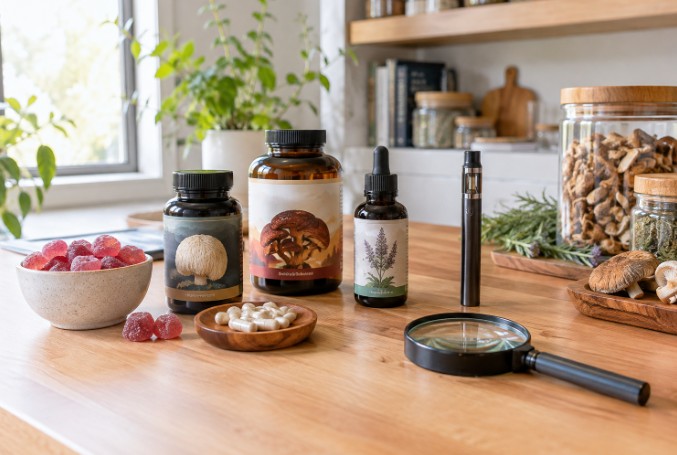
Mushroom and botanical blends now appear in several formats, including mushroom gummies, vapes, syrups, and tablets. Packaging can be colorful, and ingredient lists can sound familiar, but those details alone do not tell a buyer what is actually inside or how carefully the product was made.
This guide is intended for adults 21 and older who want a practical way to review mushroom and botanical products before making a purchase. The focus is simple: clear labels, identifiable ingredients, reliable manufacturer details, reasonable marketing, and safe storage.
A label is more than a design element. It is where a shopper can compare the format, ingredients, package directions, allergen statements, and company information. The same review habits apply whether a product comes as a gummy, syrup, tablet, or vape, although each format may present its information differently.
Ingredient transparency matters because products marketed as containing mushroom blends have been connected with serious safety incidents. In a 2024 investigation, the CDC reported 180 illnesses, 73 hospitalizations, and two associated deaths involving certain mushroom-containing products. Reviewing the details of the outbreak investigation involving mushroom-containing products shows why buyers should not rely on front-label marketing alone.
Start with the complete package, not just the front panel. A product that makes it easy to identify the maker and understand the formula is generally easier to evaluate than one that hides important details.
Names such as lion’s mane, reishi, cordyceps, chaga, and turkey tail may appear on mushroom and botanical blend labels. Seeing one of these names does not, by itself, explain which part of the mushroom was used, how it was prepared, or how much of it is included.
For example, a label may refer to a fruiting body, mycelium, powder, or extract. These are different ingredient descriptions, so they should not be treated as interchangeable. A product’s format also matters. A gummy formula may include sweeteners, colors, flavorings, and texture agents, while a syrup or tablet may use a different set of supporting ingredients.
Research associated with an ingredient does not automatically describe every finished product that carries the same ingredient name. The most useful approach is to judge the specific package in front of you, rather than assuming that a familiar mushroom name guarantees quality.
A proprietary blend is a named mixture that combines multiple ingredients while limiting the detail provided for each component. For dietary supplements, FDA labeling guidance explains that proprietary blends identify the total blend weight and list the included ingredients, but individual quantities may not be shown. The FDA’s explanation of how proprietary blends are listed on supplement labels can help shoppers recognize this format.
That does not automatically make a product unsuitable. It does mean direct comparisons become harder. A long list of mushrooms and botanicals may look impressive, yet it may offer little clarity on the role of each item. Labels that identify individual ingredients and their amounts give buyers more information to consider.
Independent laboratory testing can be a useful sign of accountability when the report is current, readable, and connected to the specific product. A certificate of analysis, often called a COA, should match the product name and, ideally, the lot number shown on the package.
Depending on the product type, a report may address ingredient identity, microbial screening, heavy metals, or other contaminants. A testing logo by itself is not the same as access to an actual report. Testing also does not remove the need to read the label, inspect the package, and consider whether the product is appropriate for the intended adult user.
When there is uncertainty about a medication, an allergy, a health condition, or an ingredient list, a qualified healthcare professional or pharmacist can help review the label. If someone experiences severe symptoms after using an unknown product, contact Poison Control or seek emergency assistance.
A careful label review is one of the most practical ways to assess mushroom and botanical blends. Clear ingredient lists, transparent manufacturer details, verifiable test results, realistic marketing, and secure storage all support more informed decision-making. When a product leaves important questions unanswered, choosing not to buy it is often the clearest choice.