Physical Address
304 North Cardinal St.
Dorchester Center, MA 02124
Physical Address
304 North Cardinal St.
Dorchester Center, MA 02124

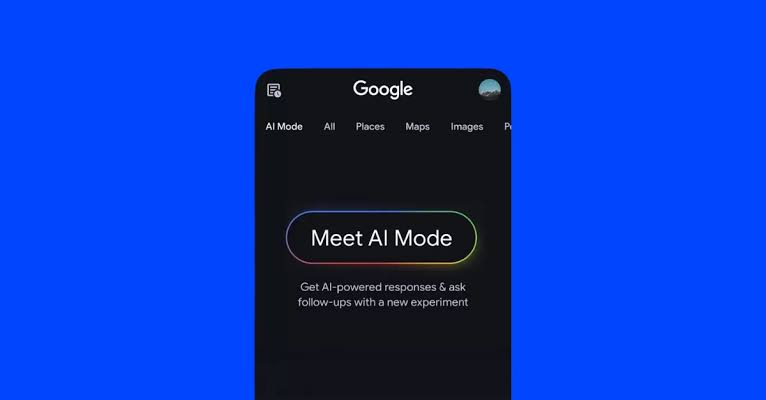
For twenty years, getting found on Google meant one thing: ranking in the list of blue links. You optimized your pages, climbed the results, and people clicked through. That world is quietly changing. Google has been rolling out AI Mode, a conversational search experience where Google itself answers the question in a few sentences, often naming specific brands, products, or companies, instead of just handing over a list of links to sort through. When someone asks about your kind of product or service and Google’s AI answers directly, one of two things happens: your brand gets mentioned, or it does not. And most businesses have no idea which.
This is a look at what AI Mode means for businesses trying to stay visible, and why tracking how you appear in it has quickly become worth doing. It is written for anyone who cares about being found online, whether you run the marketing yourself or just want to understand where search is heading. The short version is that a new and growing slice of your visibility now lives inside Google’s AI answers, a place most businesses are not watching at all, and you cannot manage what you cannot see. Getting a handle on it early, while most competitors still ignore it, is exactly the kind of quiet advantage that pays off.
Start with what is actually different, because it is a real shift, not just a new feature bolted onto the familiar results page. In traditional search, the path from question to answer ran through you: you searched, got a list of results, and clicked around to decide for yourself which to trust. Businesses optimized for that path, and being visible meant ranking high enough to get clicked. AI Mode changes the path. Now Google’s AI can read the question and answer it directly, in a conversational reply that may name a few specific brands or options and skip everything else, so the user often gets their answer without ever scrolling a list of links.
That breaks a quiet assumption the old approach relied on, which is that being findable meant being high in the rankings. In AI Mode, the question is no longer just where you rank, but whether the AI mentions you at all when it answers. If Google’s AI names a few brands in response to a question about your space and you are not among them, you were effectively invisible for that query, regardless of how your pages rank in the traditional list. The AI made a recommendation and you simply were not part of it. This is a new kind of visibility, and a new kind of invisibility, operating in a channel most businesses are not measuring, because it does not show up as a ranking change or an obvious traffic shift in the usual reports.
The reason this matters is that AI Mode is not a fringe experiment; it reflects where search is heading, toward AI increasingly answering questions directly rather than just pointing to sources. As more people get their answers this way, more of the decisions and impressions that used to happen on a results page will happen inside an AI answer instead. For a business, that means a growing share of how it is discovered and perceived depends on how it shows up in those answers. Ignoring AI Mode because the traditional rankings still look fine is like watching only half the field: the familiar half may be stable while the new half, the one that is growing, goes completely unwatched.
Here is the practical problem: with traditional search, businesses have spent years watching their rankings and traffic, able to see exactly where they stand and whether their efforts are working. With AI Mode, most businesses are flying blind. They have no idea whether Google’s AI mentions them when it answers questions about their space, for which questions, how often, or how they compare to competitors in those answers. They cannot see the new battlefield at all, which means they cannot tell whether they are winning or losing on it, or even that it exists.
That blindness is risky precisely because the stakes are rising. More of your potential customers are forming impressions and making choices based on what Google’s AI tells them, and if you have no visibility into what it says about you, you are managing a growing part of your presence on pure guesswork. You might be getting mentioned regularly, or never, and without tracking it you simply would not know. Worse, you would have no way to see which sources the AI draws on when it does mention brands, or which competitors keep showing up in answers where you are absent, information that is directly useful for understanding and improving your position. The gap is not just missing data; it is missing exactly the data you would need to do anything about it.
This is why the ability to track your presence in AI Mode has become a real discipline, as fundamental to the new era of search as rank tracking was to the old one. Understanding how to track AI Mode starts with a tool that can run the kinds of questions your customers ask against Google’s AI Mode on a recurring basis and show you whether and how your brand appears, which sources the AI cites, and which competitors turn up alongside you. PromptRush is one example of such a tool: an AI visibility platform that monitors how brands appear across AI answer engines, including Google’s AI Mode, tracking mentions, cited sources, competitors, and trends over time. That turns an invisible channel into something you can actually see, measure, and track. The principle is the same one that made traditional SEO manageable: you cannot improve what you cannot measure, so the first step in the AI Mode game is simply getting eyes on it. Once you can see where you stand, you can start to influence it; until then, you are guessing.
Seeing how you appear in AI Mode is valuable on its own, but the real payoff comes from what the data lets you do, and this is where tracking stops being a vanity metric and starts being useful. The first thing it gives you is an honest baseline: a clear picture of whether and how often your brand shows up in AI answers for the questions that matter in your space. That alone is clarifying, because it replaces assumptions with reality, and it often surprises businesses who discover they are far more, or far less, visible than they thought.
From there, the tracking data points toward concrete moves. If you can see which sources Google’s AI cites when it answers questions in your category, you learn which websites and types of content influence those answers, which tells you where to focus your efforts to improve your chances of being included. If you can see which competitors consistently appear in answers where you are missing, you learn who is winning the AI visibility game and can study what they are doing differently. And if you can watch how your presence changes over time, you can tell whether your efforts to improve are actually working, rather than guessing. This is the same feedback loop that makes traditional SEO effective, measure, understand, act, measure again, applied to the new channel of AI answers.
The broader value is that tracking AI Mode lets a business respond to the shift in search deliberately rather than passively. Instead of watching its traditional visibility while a growing new channel goes unmanaged, a business that tracks AI Mode can understand its position, spot problems and opportunities, and work to improve how it shows up in the answers that increasingly shape how customers discover and judge it. That is a meaningful advantage, especially right now, while AI Mode is new enough that most businesses are not paying attention to it. The ones that start measuring and acting early are building visibility in a channel their competitors have not even noticed yet.
Pull it together and AI Mode represents a real shift in how businesses get found, one that is easy to underestimate because the familiar rankings still look the same. As Google increasingly answers questions directly with AI, naming some brands and skipping others, a growing share of visibility now depends on whether and how you appear in those answers, not just where you rank in the traditional list. That is a new channel, and like any channel, it cannot be managed if it cannot be seen.
The practical response is straightforward: start tracking how you show up in AI Mode, so it stops being a blind spot and becomes something you can measure, understand, and improve. Knowing whether Google’s AI mentions you, which sources it draws on, and how you compare to competitors gives you the foundation to act, rather than hoping for the best in a channel you cannot see. Search is heading toward AI answering more and more directly, and the businesses that get ahead of that, by watching the new channel while others ignore it, are the ones that will stay visible as the shift accelerates. You cannot control what Google’s AI says about you until you know what it is saying, and finding that out is the first and most valuable step.