Physical Address
304 North Cardinal St.
Dorchester Center, MA 02124
Physical Address
304 North Cardinal St.
Dorchester Center, MA 02124

Direct-to-film printing has changed the way many apparel businesses approach custom garment production.
A shop can produce colorful transfers, store them for later use, and apply them to different garments as orders arrive. The flexibility is one of the reasons DTF has become so attractive to custom apparel businesses.
But DTF printing creates another challenge.
Once transfer production becomes faster, the heat press can become the next bottleneck.
For businesses that are moving from occasional orders to daily production, a dual station heat press can provide a practical way to increase workflow efficiency without immediately moving to a large industrial production line.
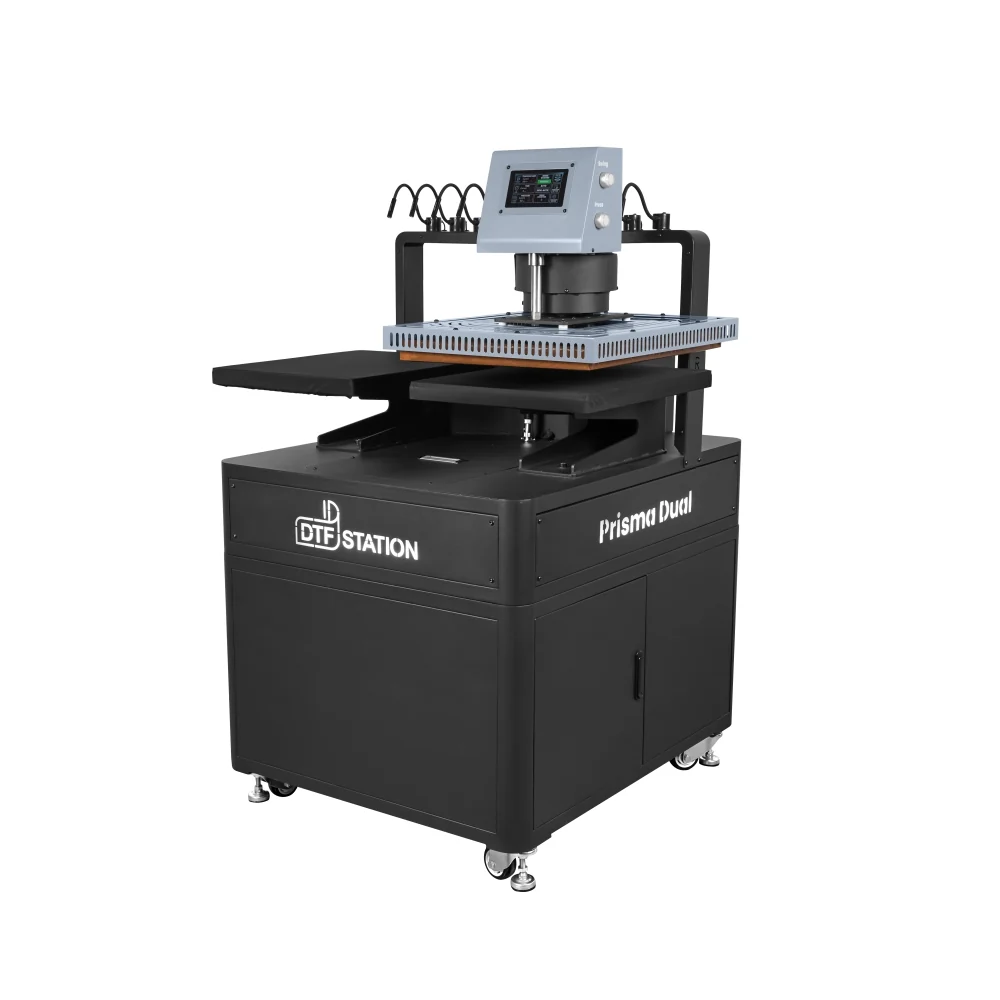
A dual station heat press has two working areas instead of one.
The operator can prepare a garment on one station while the other station is being pressed.
This sounds like a small change, but it can fundamentally change the operator’s workflow.
Consider a traditional single-station machine.
The operator must:
With a dual station setup, preparation can happen on one side while pressing occurs on the other.
The workflow becomes more continuous.
DTF businesses often receive orders with multiple garments carrying the same or similar designs.
For example, a customer may order:
The actual pressing time for each garment may be relatively short.
The problem is the accumulation of small pauses between cycles.
A dual-station machine can reduce some of those pauses by giving the operator another working area.
Instead of waiting, the operator can prepare the next garment.
The second major consideration is pressure.
Manual heat presses rely heavily on the operator to generate pressing force.
A pneumatic system uses compressed air to provide the pressing force.
For production environments, this can offer two important benefits.
The operator can set an appropriate pressure range and repeat the same process.
The operator does not need to repeatedly generate heavy mechanical pressure by hand.
That becomes increasingly important as production volume increases.
A machine that feels easy to operate for 20 shirts may feel very different after several hundred shirts.
For general apparel production, 16×20 inches is a popular format because it provides enough space for many common garment applications.
A 16×20-inch platen can handle many full-front and large-format apparel designs while still being practical for everyday T-shirt and hoodie production.
For a DTF shop, this size can also provide flexibility when garment sizes vary.
However, bigger is not always better.
A business should consider:
The correct machine is the one that matches the actual production environment.
Positioning errors can become expensive during batch production.
If a design is slightly misplaced on one shirt, the operator may be able to correct it.
If the same error happens repeatedly across an entire order, the cost can become significant.
Laser alignment provides visual reference points that can help operators position transfers more consistently.
For shops producing repeated logos or standardized designs, this can make the production process easier to reproduce.
Another feature worth considering is interchangeable lower platens.
Different apparel applications can require different working areas.
A standard platen works well for many T-shirts and hoodies, but smaller designs may benefit from smaller specialty platens.
Interchangeable platens allow one heat press to support a broader range of jobs.
This is particularly useful for businesses that don’t want to dedicate a separate machine to every application.
Not every growing DTF shop needs full automation.
A semi-automatic dual-station heat press can be an excellent option for businesses that want:
For higher-volume operations, fully automatic shuttle systems may make more sense.
The key question is:
How much of the workflow should the machine automate?
A growing shop should consider its current production volume as well as its expected volume over the next several years.
MEM’s dual heat press lineup is designed around commercial apparel decorators, DTF printing businesses, screen print shops, and promotional product manufacturers. The current range includes the semi-automatic TQ-4050 and the higher-automation TQB-4050.
The MEM TQ-4050 Dual Fusion combines a 16×20-inch dual-station configuration with pneumatic pressing, laser alignment, and interchangeable lower platens.
The MEM TQB-4050 Auto-Shuttle takes the workflow further with automated operation and foot-pedal-controlled shuttle movement, targeting businesses with greater production demands.
This type of product range allows a business to choose equipment based on its production requirements rather than simply buying the largest machine available.
Before choosing a dual station heat press, a DTF business should consider:
A shop producing 30 garments per day has different requirements from one producing 300.
If one person is running the press for several hours each day, pneumatic operation can make a meaningful difference.
If your business handles logos, sleeves, patches, or different garment types, this feature can provide additional flexibility.
If your priority is maximum operator efficiency, a fully automatic system may be worth considering.
Pneumatic machines require compressed air, so compressor capacity and working pressure should be checked before installation.
A heat press should not be evaluated only by its temperature range or maximum pressure.
For a DTF business, the more important question is:
How does the machine fit into the entire production workflow?
A good dual station heat press can help reduce idle time, improve consistency, reduce physical effort, and make repetitive production easier to manage.
For a growing DTF shop, that can be more valuable than simply buying a machine with the highest specification sheet.
The right equipment should help the business produce more consistently today while leaving enough room to grow tomorrow.