Physical Address
304 North Cardinal St.
Dorchester Center, MA 02124
Physical Address
304 North Cardinal St.
Dorchester Center, MA 02124


You wake up, stretch, and immediately feel a dull, heavy ache pulsing through your jaw joints and temples. It feels like your facial muscles ran a marathon while you slept. Most people chalk this up to everyday stress, poor sleeping posture, or clenching during vivid dreams. You take a sip of morning coffee, brush your teeth, and hope the stiffness fades as the day gets going.
Sometimes that morning tension is purely muscular. However, when the jaw works overtime under intense nocturnal pressure, the teeth bear the brunt of that force. If your morning ache centers around a specific tooth, or if breakfast brings a sharp, sudden twinge, your discomfort may not be simple muscle strain. It could be an early warning sign of a cracked molar.
Recognizing the distinction between sore jaw muscles and cracked enamel can save you from severe nerve pain, emergency root canals, or the loss of a natural tooth.
While morning muscle soreness causes a diffuse, bilateral ache across your cheeks and jaw, a cracked molar produces localized, sharp pain during chewing or rapid temperature changes.
When you clench your teeth during sleep, the masseter and temporalis muscles remain contracted for hours without rest. This results in generalized stiffness on both sides of the face that typically loosens up after you move your jaw, hydrate, or take a warm shower.
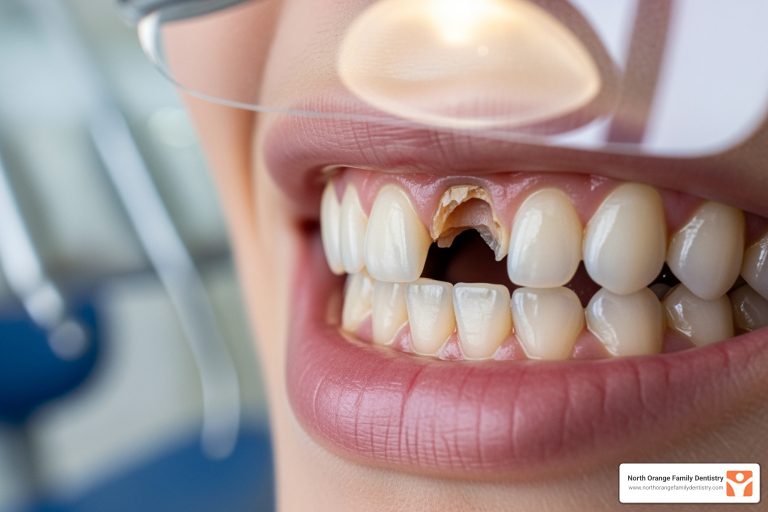
In contrast, enamel microfractures—often known clinically as cracked tooth syndrome—involve structural damage to the tooth itself. While clenching causes surrounding muscular fatigue, the physical crack flexes whenever pressure is applied. This movement irritates the underlying dentin and dental pulp, shifting the discomfort from a wide muscular ache into a distinct, sharp dental pain.
Sleep bruxism generates bite forces up to 250 pounds per square inch—far exceeding the pressure exerted during conscious daytime chewing.
During the day, natural biofeedback mechanisms protect your teeth: if you bite down too hard on an unexpected seed, your nervous system reflexively halts your jaw muscles to prevent trauma. During deep sleep, those protective reflexes are suppressed. Unconscious grinding exerts sustained, lateral shearing forces directly against the interlocking cusps of your molars.
Over months or years, these heavy, cyclical forces create microscopic craze lines across brittle outer enamel. If a tooth already harbors a large filling, the structural integrity of the remaining natural enamel is further weakened. Eventually, microscopic fissures deepen into structural cracks that wedge apart during nocturnal grinding episodes.
If your morning discomfort includes any of the following symptoms, the issue has likely transitioned from simple jaw strain to damaged enamel:
Dental enamel does not contain living cells and cannot regenerate or heal itself once a structural fracture develops.
Cracks generally progress through distinct stages if left untreated:
Misunderstandings about dental pain often cause patients to delay necessary care until extensive damage occurs:
Accurately identifying a cracked molar requires specialized diagnostic tools combined with a personalized restorative treatment plan.
Dentists utilize high-intensity transillumination, specialized bite tests, and 3D digital imaging to track hairline fractures along tooth cusps. Once pinpointed, treatment depends on the depth of the fracture line. Minor surface cracks can often be sealed with composite bonding, while deeper cracks require an onlay or a full-coverage crown to bind the weakened cusps together and prevent the crack from spreading into the root.
To stop the underlying cause of tooth fractures, working with experienced Anchorage dentists ensures you receive an accurate diagnosis and a custom nightguard designed from digital intraoral scans. Unlike soft retail alternatives, a rigid, custom-milled occlusal splint distributes bite forces evenly across the dental arch, decompressing the jaw joints and shielding your molar enamel from damaging nocturnal pressure.
Morning jaw soreness is more than an annoying start to your day—it is an important physiological signal that your jaw muscles and teeth are under sustained mechanical stress. When persistent stiffness is accompanied by sharp bite discomfort, temperature sensitivity, or localized molar ache, overlooking the problem allows hairline fissures to deepen into catastrophic fractures. Addressing sleep bruxism early with professional guidance preserves your natural tooth structure, relieves jaw tension, and keeps your smile intact for years to come.